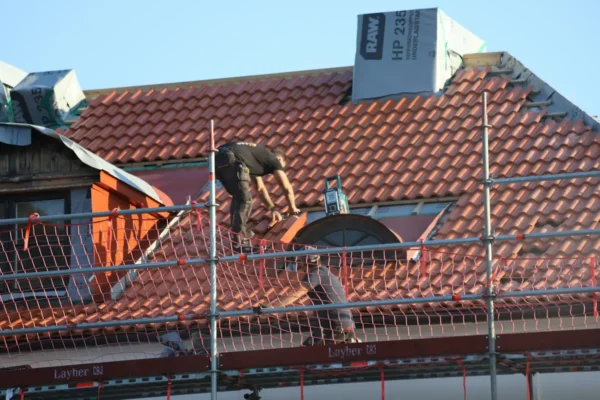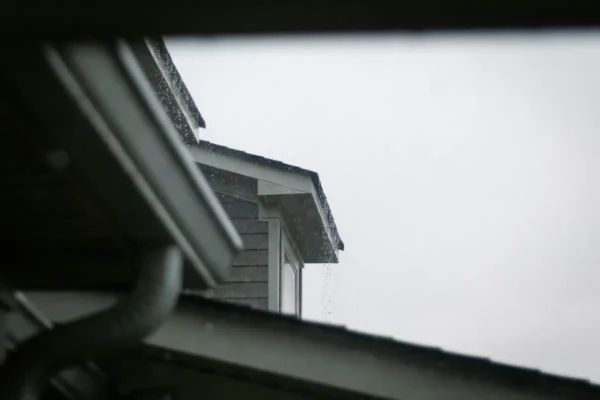
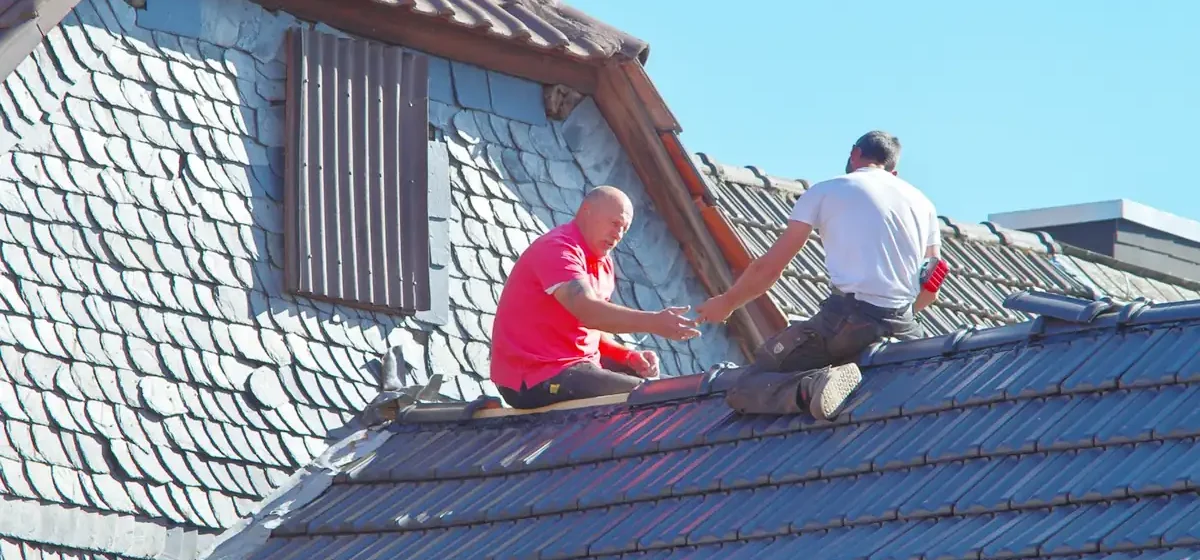
Water pouring over the edge of a gutter during rain is one of the most common sights on a Manchester street, and one of the most underestimated. Gutter cleaning in Manchester is often treated as a tidying job to get round to eventually. In practice an overflowing gutter is the start of a chain that ends in damp plaster, rotten joist ends and a repointing bill. This explainer sets out why gutters block, what the overflow actually does to a house, and what cleaning, gutter repair and replacement involve.
How a gutter blocks
A gutter is a shallow channel with a slight fall towards a downpipe. It only needs a small obstruction to stop working. Leaves are the obvious culprit, but on most houses the real problem is finer material: moss washed off the roof tiles, grit from the surface of concrete tiles, wind-blown soil and seeds. This settles into a sludge that holds water, grows grass and weeds, and eventually fills the channel. Downpipes block at the top, where the outlet narrows, and at the bottom where the pipe meets the gully. Sagging brackets create low points that hold water and silt, and a joint that has failed will leak even when the gutter is clear. Once water stands in the gutter it freezes in winter, which can split uPVC and crack cast iron.
What the overflow does to the house
- Saturated brickwork. Water running down the outside wall soaks the bricks and mortar. Red brick is porous, and repeated wetting followed by frost causes spalling, where the face of the brick breaks away, and washes out the mortar joints.
- Penetrating damp inside. A solid wall with no cavity, which describes most pre-1920s houses, passes that moisture straight through to the plaster. The classic sign is a damp patch high on an upstairs wall, often mistaken for a roof leak.
- Rotten timber. Water running behind the gutter reaches the fascia board, the ends of the rafters and, in older houses, the joist ends built into the wall. Wet rot follows, and eventually structural repair.
- Foundations and gullies. A downpipe discharging onto the ground beside the house rather than into a drain saturates the soil and can cause movement in older footings, and it floods the air bricks that ventilate a suspended timber floor.
- Decoration and mould. Damp plaster blisters paint, lifts wallpaper and feeds black mould, which is a health matter and, in rented homes, a legal one.
What is different in Manchester
Manchester’s housing is defined by the red-brick terraces of the late nineteenth and early twentieth centuries in Levenshulme, Moss Side, Rusholme, Gorton and Salford, with interwar semis spreading through Didsbury, Chorlton, Burnage and the suburbs, and a large stock of city-centre apartments built since the 1990s. The terraces have solid walls and, very often, shared gutters running the length of a row, so a blockage at one house backs water up along the neighbours’ sections and a dispute over who pays for gutter repairs is common. Many still have original cast iron on brackets that have rusted, where replacement in matching cast iron or aluminium is a sensible investment. The city’s climate is the other factor: the Met Office records Manchester as one of the wetter major cities in England, with rain on a high proportion of days through autumn and winter, so gutters work harder here and block faster. Manchester City Council and the other nine Greater Manchester boroughs handle their own building control and planning, and several conservation areas in the older suburbs restrict visible changes to the front of a house, including swapping cast iron for plastic.
What gutter cleaning in Manchester involves
Most gutter cleaners near me searches turn up firms using one of two methods. Ground-based vacuum systems use a long carbon-fibre pole with a camera, which clears leaves and sludge from a two-storey house without a ladder and is quick and safe. Hand clearing from a ladder, tower or scaffold is slower but allows the operative to see joints, brackets and the fascia, and to make minor repairs on the spot. A good firm will flush the downpipes afterwards and check that water runs to the outlet, and will tell you if a section is sagging or a joint has failed. If the gutter has been overflowing for years, ask for the fascia and soffit to be checked too.
Gutter repair and replacement
Cleaning solves a blockage but not a defect. Gutter repair covers resealing or replacing joints, refitting brackets to restore the fall, and replacing cracked lengths. Gutter replacement is the answer when uPVC has gone brittle, cast iron has rusted through, or the brackets have pulled out of soft fascia timber. Replacement is typically priced per metre, with uPVC cheapest and cast iron or aluminium costing more but lasting longer and suiting period houses. Gutter guards, whether brush, mesh or hedgehog style, reduce leaf build-up but still need checking, and they are not a substitute for cleaning in a city with this much rain. For any of this, get written quotes and ask whether the fascia behind the gutter is sound.
When to call a professional
Clearing a ground-floor gutter with a pole is a reasonable household job; anything that means a ladder against a first-floor gutter is not. The Health and Safety Executive’s work at height guidance applies, and the firm should use ground-based equipment, a tower or scaffold. A roofer in Manchester working on an older house should also be alert to asbestos cement in soffits and garage roofs on homes built before 2000, and to the Environment Agency’s requirement that gutter sludge and old guttering taken away leave with a registered waste carrier. Where water has got into the wall near sockets or light switches, have a registered electrician check before using them.
If you need help finding a firm for gutter cleaning in Manchester, or a roofer to deal with the fascia and tiles behind the problem, describe the job to The Household Daily’s help desk and the team will help you take the next step.
Questions people ask
How can I tell if damp inside is from the gutter rather than the roof?
Gutter damp shows at the top of an outside wall or around a window, directly below the gutter line, and gets worse after heavy rain. Roof leaks usually show in the middle of a ceiling or next to a chimney. Looking at the outside wall below the gutter after rain will often settle it.
Who pays for a shared gutter on a terrace?
In most terraces each owner is responsible for the section of gutter on their own house, but a blockage on one property affects the neighbours. The usual approach is to agree a joint clean and split the cost. Check the deeds if there is a dispute, as some impose shared maintenance obligations.
Should I replace cast iron gutters with plastic?
Not necessarily. Cast iron that is sound can be cleaned, primed and repainted and will last decades more. If it has rusted through, aluminium or new cast iron keeps the look of a period house. In a conservation area the council may expect a like-for-like material on the front elevation.
Ready to take the next step?
Tell the household desk what has happened, where you are and when you need help. We will review it and explain your options.
Describe your job →Guidance is general and refers to the authority that sets each rule. Costs are indicative ranges; always get written quotes. Trade availability and credentials are confirmed when you enquire.