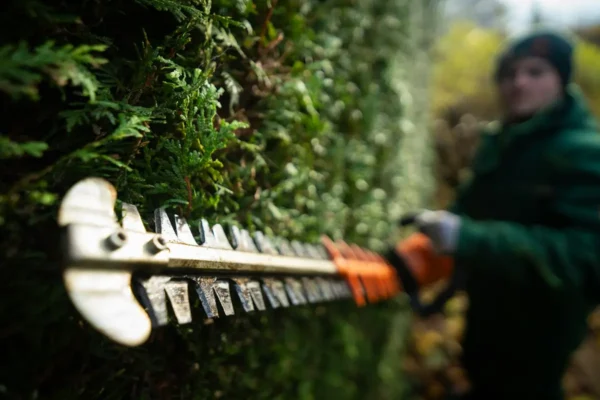
Hedge trimming in Bromley is a once or twice a year job for most households, and it is the one gardening task where a little preparation on your side makes a clear difference to the price and the result. The borough’s suburban semis and detached houses have long boundary hedges, often privet, laurel or conifer, and a gardener who arrives to find the base clear, the neighbour warned and the waste plan agreed will be done in half the time. This checklist runs from booking to the day after.
Before you book
- Check the season. The familiar warning that gardeners must avoid hedge trimming to protect nesting birds is a legal point, not a courtesy: the Wildlife and Countryside Act 1981 makes it an offence to damage an active nest, and the RSPB advises against cutting between March and August. Late August to October and late winter are the usual windows. Formal evergreen hedges can take a light summer trim only after a careful check for nests.
- Measure the hedge. Length, height and how far it has spread. Hedge trimming cost is driven by height more than anything else, because anything over about two metres needs platforms rather than a step and takes longer per metre.
- Decide the cut. A trim takes off this year’s growth; a reduction takes the hedge down or back hard. Reductions of conifer hedges need thought, because Leyland cypress does not regrow from old wood and a hard cut leaves brown patches permanently. Laurel, privet, beech and yew all recover well.
- Talk to the neighbour. A boundary hedge is usually shared. You can cut your side to the boundary line without permission but not beyond, and height reductions on a shared hedge need agreement. The council can act on complaints about evergreen hedges over two metres under the Anti-social Behaviour Act 2003, so a neighbour’s complaint is a reason to talk, not to ignore.
- Check for protection. Hedges are not covered by Tree Preservation Orders, but individual trees within a hedge line can be, and much of the borough is conservation area; ask Bromley Council if in doubt.
- Get a written quote from hedge trimming services that states the height to be cut to, whether waste removal is included and whether the gardener holds public liability insurance.
The week before
- Clear the base of the hedge on your side: pots, bins, bikes, garden furniture, anything within a metre.
- Walk the hedge for hazards: a hidden fence, a wire, a wasps’ nest, a cable to a shed. Tell the gardener about all of them.
- Confirm access. Will the gardener work from your side, the neighbour’s or the pavement? A pavement hedge may need a cone or two and should not be cut in school-run traffic.
- Confirm the waste plan. Bromley Council’s garden waste collection is a paid subscription and a trimmed hedge fills a brown bin many times over; most gardeners Bromley wide remove it for a disposal charge. They must be registered waste carriers with the Environment Agency.
- Check the forecast. Wet hedges clog trimmers and wind makes platform work unsafe; a gardener may move the date, and that is a sign of a careful one.
On the day
- Be in, or leave clear instructions and a contact number; the gardener will have questions about height and shape.
- Provide an outdoor power point if the gardener uses electric tools, and keep the cable route clear.
- Keep pets and children indoors while cutting is under way; hedge trimmers throw debris.
- Agree the finished height on the first section before the whole length is cut. A hedge can always be taken lower; it cannot be put back.
- Ask for the faces to be slightly tapered so the hedge is narrower at the top than the base; it lets light reach the lower growth and keeps it dense.
- Walk the job before paying. Check both faces, the top line and that clippings have been raked from the lawn and borders.
What is different in Bromley
Bromley is London’s largest borough by area and most of it is suburban, with the big gardens and long boundary hedges that go with 1930s semis and post-war detached houses. That makes hedge trimming and pruning a larger share of the garden maintenance Bromley householders pay for than in inner London, and conifer screens planted decades ago are now the borough’s standard problem hedge. Access is generally good, with driveways and side gates, so platform equipment can be brought in and waste taken out without going through the house. The chalk soils across much of the south of the borough drain fast and suit yew and beech; the clay further north favours laurel and privet. Many residential streets are in conservation areas, and the council’s garden waste collection runs as an annual brown bin subscription, so for a big hedge the gardener’s disposal charge is usually the practical route.
When to call a professional
A hedge you can reach from the ground with a hand or electric trimmer is a householder job. Anything that needs a platform or a ladder is work at height; the Health and Safety Executive’s guidance applies to paid work, and the usual cause of injury is a trimmer used one-handed from a ladder. Reductions that need a chainsaw should be done by someone with an NPTC certificate of competence. If the hedge contains trees that are protected, Bromley Council’s consent is needed first. An old asbestos cement garage roof alongside the hedge should not be used as a platform or disturbed; pre-2000 outbuildings are the usual place to find it. And waste must go with a registered carrier, since the householder keeps a duty of care for it.
If you want help finding someone for hedge trimming in Bromley, describe the hedge, its length and height, and the access to The Household Daily’s help desk and we will help you take the next step.
Questions people ask
When can I have a hedge trimmed in Bromley?
Late August to October and late winter are the usual windows. The Wildlife and Countryside Act 1981 protects active nests, and the RSPB advises against cutting between March and August unless the hedge has been checked carefully.
Can I cut my neighbour's side of a shared hedge?
No. You can cut your side back to the boundary line, but height reductions or anything beyond the line need the neighbour's agreement. Talk to them before booking.
Will a hard cut kill a conifer hedge?
Leyland cypress does not regrow from old wood, so cutting into brown growth leaves permanent bare patches. Laurel, privet, beech and yew recover from hard reductions.
Ready to take the next step?
Tell the household desk what has happened, where you are and when you need help. We will review it and explain your options.
Describe your job →Guidance is general and refers to the authority that sets each rule. Costs are indicative ranges; always get written quotes. Trade availability and credentials are confirmed when you enquire.