
Woking’s housing splits into three broad types, and a house clearance in Woking is a different job in each. The interwar semis that line the roads out towards the villages, the post-war houses and bungalows built in the decades after, and the apartment blocks that have gone up around the station and town centre in the last twenty years all present different problems of access, volume and hazard. Knowing which you are dealing with is the first step towards an accurate quote.
House clearance in Woking’s 1930s semis: loft and garage
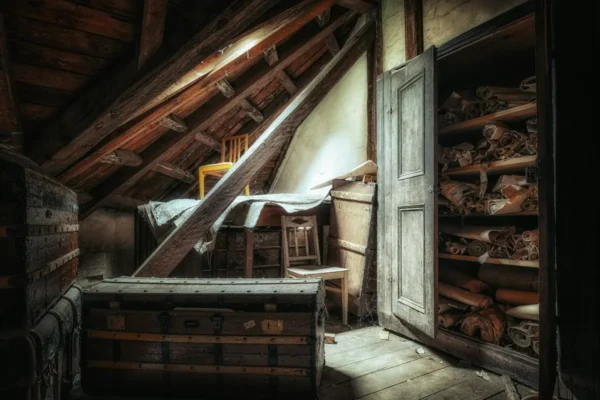
The classic Woking semi has a long loft under a pitched roof, a detached or attached garage, a shed and a garden that runs further back than you expect. If the same family has lived there since the 1960s or 1970s, the loft and garage will hold more than the house. Clearance firms price this type on van loads, and the honest estimate for a full semi with full outbuildings is usually two or more loads over a long day or two.
Specific points for this type: original garages with corrugated roofs may be asbestos cement, which must not be broken up by the crew; built-in cupboards beside chimney breasts hide decades of paperwork, which is heavy; and front gardens are often paved for parking, so van access is good. Textured ceiling coatings applied in the 1970s may contain asbestos, so if any ceiling is damaged, mention it when you ask for a quote. These are the things that most affect the cost of a house clearance on a property of this age, far more than the number of bedrooms.
Post-war houses and bungalows
Woking expanded considerably after the war, and the houses and bungalows from the 1950s to the 1970s are a large share of what comes up for clearance. They are simpler to clear than the semis: wider doorways, straight staircases or none at all, and smaller lofts. Bungalows in particular are quick jobs for a crew, with everything on one level and the van at the door.
The hazards here are electrical and material rather than structural. Storage heaters, which are common in homes of this period, are extremely heavy and contain bricks that must be removed before the unit is moved, and the heater must be disconnected by a competent electrician first. Older fridges and freezers are collected as hazardous waste. Soffits, floor tiles and boiler cupboard linings from this era may contain asbestos. A house clearance in Woking, Surrey of this type is often quoted lower than a semi of the same size, and the reason is simply fewer awkward spaces.
Town-centre apartments and flat clearance
The newer apartment blocks around the station are the opposite problem: little volume, but tightly controlled access. A flat clearance here depends on the managing agent. Most blocks require a lift booking, limit the hours when moves can take place, insist on protective coverings in the lift and corridors, and have a loading bay with a time limit rather than street parking. Some require proof of the firm’s insurance before it is allowed on site. The crew may need fobs or a concierge to let them through doors that lock behind them.
Tell the firm the floor, whether there is a lift and its size, where the van can stand and what the block’s rules are. A flat that would take a crew two hours in a house can take half a day if the lift is small and the loading bay is three minutes’ walk away. Leaseholders should also check the lease for any restriction on contractors’ hours.
What is different in Woking
Woking Borough Council offers a paid bulky waste collection for a limited number of items, collected from an agreed point on a booked date, and that is worth comparing against a private quote if all you have is a sofa and a mattress. The community recycling centre serving the borough is run by Surrey County Council, with rules on van and trailer access, so check before loading a hired van. The town centre has controlled parking and loading restrictions around the station and the shopping centre, and a clearance van needs either a loading bay slot arranged through the block or a dispensation from the council. House clearance prices in the town reflect that: suburban semis with driveways are quoted on volume alone, while apartments carry an access premium, and firms covering house clearance in Surrey more widely will usually say so if asked.
When to call a professional
Across all three property types the same lines apply. Gas cookers, hobs and fires must be disconnected by a Gas Safe registered engineer before they are moved. Storage heaters, electric showers and any hard-wired appliance need a competent electrician, and work on circuits or the consumer unit is notifiable under Part P of the Building Regulations. Any home built before 2000, which is every semi and post-war house in the town, may contain asbestos; the HSE guidance is not to disturb suspected material and to use a specialist for removal. Whoever takes the waste away must be registered with the Environment Agency as a waste carrier, and you should keep the waste transfer note as evidence that you met your duty of care. If a property has stood empty and shows signs of rodents or wasps, a pest control professional with RSPH or BPCA qualifications should deal with it before the crew works in the loft.
Getting the right quote for the right property
- Semi: photograph the loft, garage and shed as carefully as the rooms.
- Post-war house: list the storage heaters and any suspected asbestos.
- Apartment: send the block’s rules, the lift size and the loading bay location.
- All types: get at least two written quotes on the same scope.
Tell The Household Daily’s help desk which type of property you have and roughly how full it is, and we will help you take the next step.
Questions people ask
Is a flat cheaper to clear than a house in Woking?
Usually there is less volume, but access adds time. Lift bookings, loading bay limits and managing agent rules can make a small flat take as long as a larger house with a driveway.
Can a clearance firm remove storage heaters?
Only after a competent electrician has disconnected them. The bricks inside must be removed before the unit is moved because of the weight.
Does Woking Borough Council collect bulky waste?
Yes, a paid collection for a limited number of items on a booked date. For a full house clearance you need a private firm registered with the Environment Agency.
Which parts of a 1930s semi might contain asbestos?
Corrugated garage roofs, textured ceiling coatings, floor tiles and old boiler cupboard linings. Do not disturb suspected material; the HSE advises using a specialist.
Ready to take the next step?
Tell the household desk what has happened, where you are and when you need help. We will review it and explain your options.
Describe your job →Guidance is general and refers to the authority that sets each rule. Costs are indicative ranges; always get written quotes. Trade availability and credentials are confirmed when you enquire.