A large share of the housing in Reading and across Berkshire was built between 1960 and 1990: the estates of Lower Earley, Woodley, Tilehurst and Calcot, the Bracknell new town neighbourhoods, and the expansion of Slough, Maidenhead and Newbury. These houses are now forty to sixty years old, and their wiring is at an age where electricians in Reading, Berkshire see the same handful of problems again and again. This guide explains what was typical when these homes were built, what has usually been changed since, what an EICR tends to find, and what the sensible upgrades are.
What a 1960s to 1980s house was built with
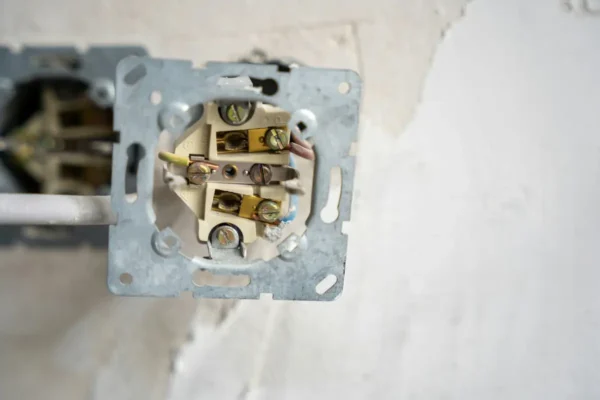
Most of these homes were wired in PVC twin and earth cable, which is still the standard today and generally lasts well. The 1960s stock may have earlier grey-sheathed cable with smaller conductors, and a few early examples still have imperial sizes. The consumer unit was usually a rewireable fuse board or, from the mid 1970s, an early board with miniature circuit breakers but no RCD protection at all. Lighting circuits in 1960s houses were sometimes run without an earth, which becomes a problem the moment a metal light fitting is installed. Sockets were few by modern standards, one or two per room, which is why so many have since been added on spurs. Electric storage heaters on an off-peak tariff were common on estates without mains gas, with a second meter and a separate board.
What has usually been done since
Almost every house of this age has had something added: a kitchen extension with its own ring, a loft conversion, a garage supply, an electric shower, outside lights. The quality varies enormously. Where a competent electrician did the work, you will find an electrical installation certificate; where a previous owner did it, you will find junction boxes under the floor and cable clipped along skirting boards. Consumer units have often been swapped once, typically in the 1990s or 2000s, for a split-load board with a single RCD, which is better than nothing but means one fault turns off half the house. Kitchens are the worst affected rooms: the original two sockets have become ten, often all on one ring with a spur off a spur.
What an EICR typically finds
- No RCD protection on socket circuits, or a single RCD covering everything: usually a C2 or C3 depending on the detail.
- Lighting circuits without an earth where metal fittings or switches have been fitted: a C2.
- Main bonding to gas and water pipes missing or undersized: common in houses built before 1980 and a frequent C2.
- Electric showers on cable too small for the current shower, because the shower was upgraded but the circuit was not.
- Spurs off spurs in kitchens, and sockets on lighting circuits.
- Old plastic consumer units with signs of heat, and rewireable fuses that have been fitted with the wrong wire.
Few of these houses need full electrical rewiring. The cable is usually sound. What they need is a new consumer unit with RCBOs, bonding brought up to standard, a few circuits corrected and the lighting earthed if it is not. As a rough guide, that package typically costs a fraction of a rewire; get written quotes based on an inspection rather than a phone estimate.
Sensible upgrades for this type of home
- Consumer unit with RCBOs. Each circuit protected on its own, so a faulty appliance does not take out the freezer.
- Surge protection. Now recommended in the wiring regulations and cheap to include when the board is changed.
- Kitchen ring reorganised when the kitchen is next refitted, with dedicated circuits for the oven, hob and any large appliances.
- EV charger. Most of these houses have a drive and a garage, which makes installation straightforward, but the incoming supply fuse and the earthing arrangement must be checked first. Good EV installers will also check whether the network operator needs to upgrade the cut-out.
- Heating changes. Replacing storage heaters with a heat pump or panel heaters changes the load and the tariff wiring, and needs planning with the electrician.
What is different in Berkshire
Berkshire has no county council; it is run by six unitary authorities, so building control and Part P notifications go to Reading Borough Council, Wokingham Borough Council, West Berkshire Council, Bracknell Forest Council, Slough Borough Council or the Royal Borough of Windsor and Maidenhead, depending on the address. The housing is unusually consistent, which means a local electrician who has worked on one Lower Earley house has a good idea of what is behind the walls of the next one, and quotes should be correspondingly firm. The newer estates built since 2000 around Green Park, Jennett’s Park and Shinfield are a different proposition: modern consumer units, RCD protection throughout and an electrical certificate in the handover pack, so for those homes the question is more often about adding capacity for EV chargers and home offices than about safety.
When to call a professional
Changing a consumer unit, adding a circuit, installing an EV charger and any bathroom or outdoor work are notifiable under Part P of the Building Regulations in England and should be done by someone registered with NICEIC, NAPIT or a similar competent person scheme. EV charger installers should also be familiar with the current requirements for home charge points. Houses of this era commonly contain asbestos in textured ceilings, soffits, floor tiles and old storage heater panels, and an electrician who needs to drill through them should stop and advise. Gas boiler work is for Gas Safe registered engineers only.
If you own a house of this type and want an inspection or an upgrade, describe it and your postcode to The Household Daily’s help desk and we will help you take the next step with electricians in Reading or elsewhere in Berkshire.
Questions people ask
Does a 1970s house in Reading need rewiring?
Usually not. PVC cable from that era is generally sound. What is normally needed is a new consumer unit with RCD protection, main bonding brought up to standard and any badly added circuits corrected. An EICR will tell you which, and a quote should follow an inspection, not a phone call.
What is main bonding and why does the EICR mention it?
Bonding connects the incoming gas and water pipes to the earthing system so that, in a fault, metal pipework cannot sit at a dangerous voltage. Houses built before about 1980 often have it missing or undersized, and it is a common C2 item on reports for Berkshire estate homes.
Can I have an EV charger installed in a 1980s house in Berkshire?
In most cases, yes. The installer needs to check the size of the incoming supply fuse, the earthing arrangement and the condition of the consumer unit. Some homes need a cut-out upgrade from the network operator first, which the installer can request.
Who handles building control in Berkshire?
The six unitary councils: Reading, Wokingham, West Berkshire, Bracknell Forest, Slough and the Royal Borough of Windsor and Maidenhead. A registered electrician notifies Part P work to the right one for your address.
Ready to take the next step?
Tell the household desk what has happened, where you are and when you need help. We will review it and explain your options.
Describe your job →Guidance is general and refers to the authority that sets each rule. Costs are indicative ranges; always get written quotes. Trade availability and credentials are confirmed when you enquire.