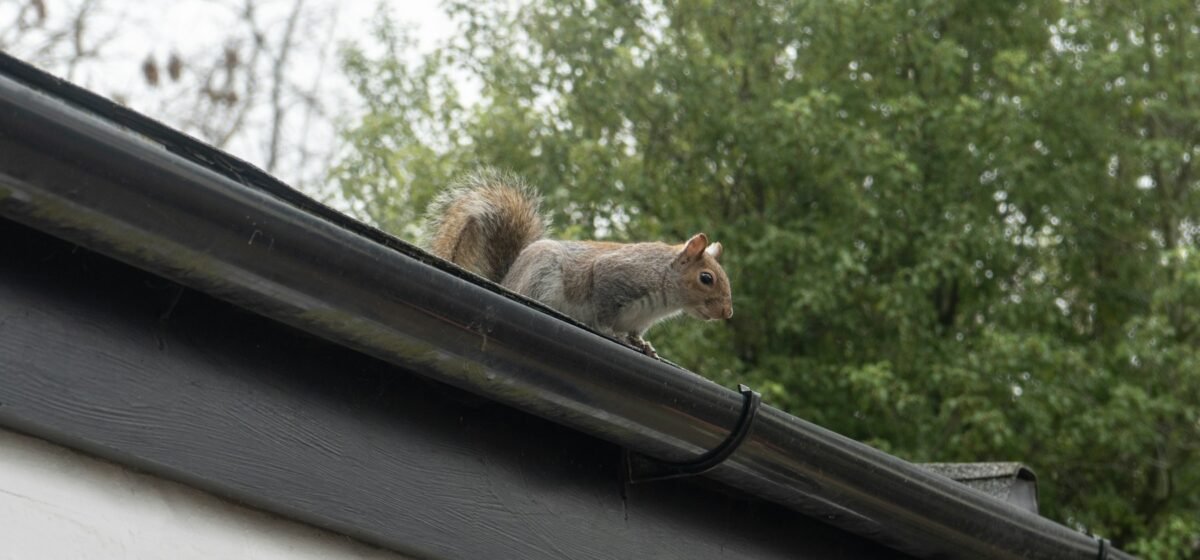
Scrabbling overhead at dawn and dusk, and the sound of something heavier than a mouse running the length of the ceiling, usually means squirrels in loft spaces rather than rats. Guildford’s mature gardens and woodland edges make it one of the more squirrel-prone towns in Surrey. This guide covers how to confirm what you are hearing, the damage squirrels do, what the law says about grey squirrels, and how pest control removes and proofs against them.
How to tell squirrels from rats and mice
Timing is the best clue. Squirrels are active by day, with peaks just after sunrise and before dusk, while rats and mice are mostly nocturnal. Squirrels sound heavy and fast, with bursts of running and a rolling noise as they move stored food or nesting material. Rats produce a steadier scurrying and gnawing through the night.
If you go up with a torch, look for a drey: a football-sized ball of leaves, shredded insulation and twigs, often tucked against the eaves or a chimney breast. Squirrel droppings are rounded and about the size of a raisin, scattered rather than in trails. Chewed cables with exposed copper, stripped loft insulation and daylight showing at the eaves or soffit confirm the diagnosis. Our guide to pest control season by season explains why the problem peaks between November and February, when females look for a dry place to raise a litter.
What the damage looks like
Squirrels gnaw constantly because their incisors never stop growing, and squirrels in loft spaces have plenty to work on. The most serious risk is to electrical cable. Chewed insulation on lighting circuits is a fire hazard and a cause of tripped circuits that electricians are called to every winter. Any damaged wiring needs a registered electrician, and the NICEIC or NAPIT registers are the places to check credentials.
- Stripped mineral wool insulation, which reduces its performance and pushes heating bills up.
- Gnawed roof timbers, rafters and the plastic of water tank lids and pipe lagging.
- Chewed soffits, fascias and lead flashing where they enlarge an entry hole.
- Urine staining on ceilings beneath the nest and a persistent smell in the rooms below.
- Damage to stored belongings, cardboard boxes and Christmas decorations.
Home insurance rarely helps. Most buildings policies exclude damage caused by vermin, and squirrels are classed as such, so the cost of repairs and removal usually falls on the homeowner. It is worth reading the policy wording before assuming otherwise.
Squirrels in loft spaces and the law
Grey squirrels are an invasive non-native species. Under the Invasive Alien Species (Enforcement and Permitting) Order 2019, which sits alongside Schedule 9 of the Wildlife and Countryside Act 1981, it is an offence to release a grey squirrel back into the wild once it has been caught. A trapped grey squirrel must be humanely dispatched, and in practice that means a trained professional rather than a householder with a cage trap and good intentions. Red squirrels are protected and must not be harmed, but they are absent from Surrey.
The Animal Welfare Act 2006 applies too. Traps must be checked at least daily, glue boards are illegal for this purpose, and poisoning squirrels is not permitted with any product sold to the public. Blocking the entry hole while an animal is inside leaves it to die in the roof space and, apart from the welfare issue, produces a smell that lasts weeks. The British Pest Control Association lists member firms who work within these rules.
What is different in Guildford
Guildford sits on the chalk of the North Downs with the Surrey Hills to the south, and the town is ringed by oak and beech woodland, parkland and large gardens with mature trees. That is ideal grey squirrel habitat, and the population feeds on garden bird tables year round. Houses with trees overhanging the roof are the most exposed, because a squirrel can drop onto the tiles from a branch and never needs to climb a wall.
Housing stock matters as well. The Victorian and Edwardian terraces around the town centre and Charlotteville have open eaves, loose slates and shared roof voids that let squirrels move between houses. The 1930s semis in Burpham, Merrow and Stoughton often have timber soffits that have softened with age.
The newer estates at Park Barn and Bellfields are tighter, but uPVC fascias fitted over old timber still leave gaps at the corners. Expect prices to sit at the higher end of national ranges, as they do across Guildford and the rest of the south east.
Removal, proofing and what it costs
A professional visit for squirrels in loft spaces starts with an inspection to find the entry points, confirm the species and check for young. Trapping follows, using cage or spring traps set in the loft and checked daily over one to two weeks. Once activity stops, the proofing work begins, and this is the part that determines whether the problem comes back.
- Seal gaps at the eaves, soffits and fascia boards with galvanised mesh or metal flashing, not expanding foam, which squirrels chew through in a night.
- Fit mesh behind ventilation grilles and over chimney pots without a cowl.
- Cut back branches to leave at least two metres between tree and roof.
- Replace stripped insulation and have any chewed wiring inspected and repaired.
As an indicative range, a squirrel treatment with several visits costs £150 to £300 in Surrey, with proofing added at £100 to £400 depending on access and the length of eaves to seal. Scaffolding or a cherry picker for a three-storey roof adds more. Our Bromley guide to how much pest control costs breaks down what moves the price. Guildford Borough Council does not run a domestic squirrel service, so this is private contractor work.
When to call a professional
Call as soon as you confirm squirrels in loft spaces rather than waiting for the noise to stop on its own. Each week adds chewed cable and shredded insulation, and a litter born in the roof means more animals to remove in spring. If you see scorched cable or a tripping circuit, switch the lighting circuit off at the consumer unit and call an electrician first.
Our help desk reviews pest enquiries in Guildford, confirms availability and checks credentials before anything is agreed. It is free, and nothing is booked until the team confirms. Request help here.
Questions people ask
Can I remove squirrels from my loft myself?
You can seal entry points once the loft is empty, but trapping is best left to a professional. A grey squirrel caught in a cage cannot be released under the Invasive Alien Species (Enforcement and Permitting) Order 2019 and must be humanely dispatched, which most householders are neither trained nor willing to do. Traps must also be checked daily under the Animal Welfare Act 2006.
Will squirrels leave the loft on their own?
Sometimes in spring, once the young have left the drey, but they usually return the following autumn to the same warm roof, and the entry hole stays open to other animals in between. Loud noise and strong smells rarely work for long. The reliable approach is removal followed by proofing of every gap at the eaves, soffits and ventilation points.
Do squirrels in the loft cause fires?
They can. Squirrels gnaw the plastic sheathing on lighting cables, exposing live conductors that can arc against timber or insulation. Chewed wiring is a recognised cause of loft fires and tripping circuits. If you find damaged cable, isolate the circuit at the consumer unit and have an NICEIC or NAPIT registered electrician inspect and repair it before the lights go back on.
How much does squirrel removal cost in Surrey?
As an indicative range, a treatment with several trapping visits costs £150 to £300, with proofing of the eaves and soffits adding £100 to £400 depending on access. The south east runs higher than the national average, and high roofs that need scaffolding or a cherry picker cost more. Councils in Surrey do not offer a domestic squirrel service, so the work is private.
Ready to take the next step?
Tell the household desk what has happened, where you are and when you need help. We will review it and explain your options.
Describe your job →Guidance is general and refers to the authority that sets each rule. Costs are indicative ranges; always get written quotes. Trade availability and credentials are confirmed when you enquire.